Português
 English

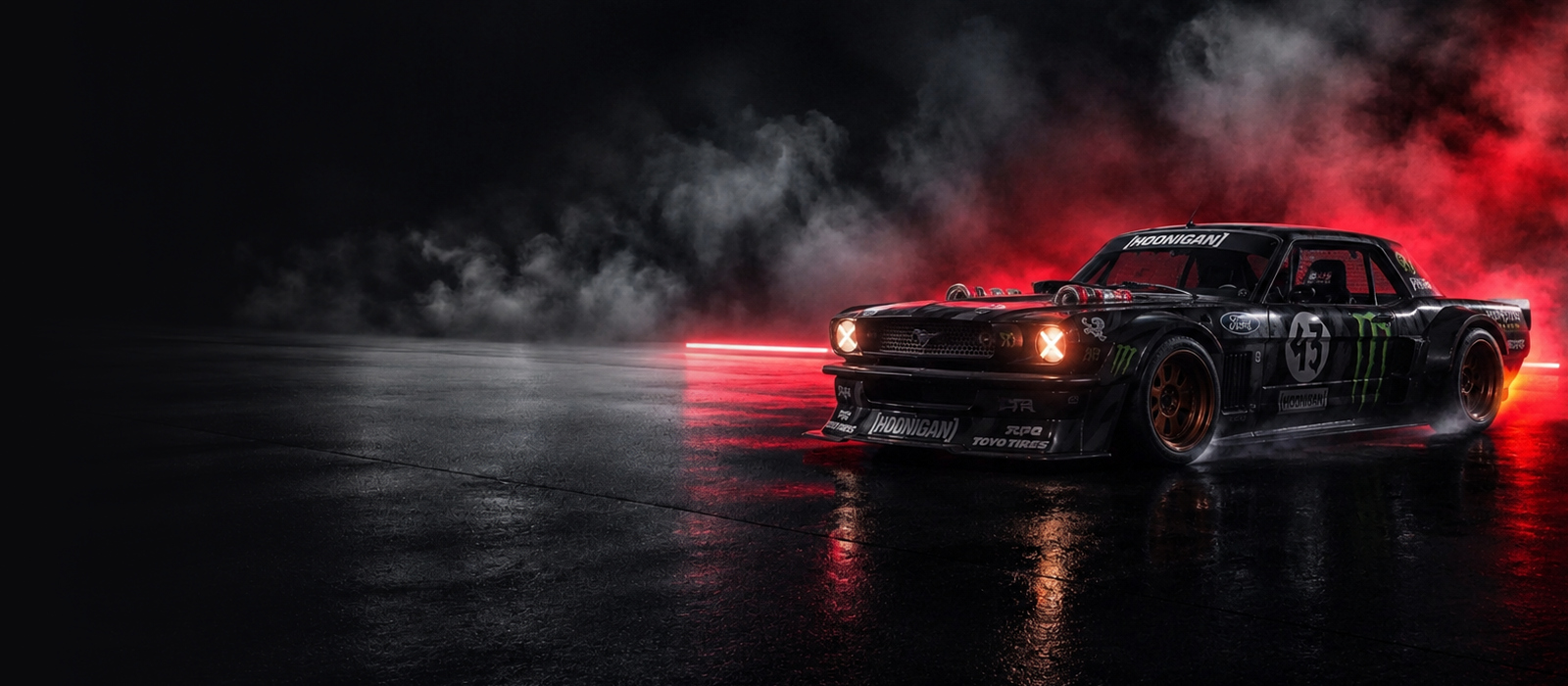
The Ford Mustang Hoonicorn is not just a modified Mustang. It is probably one of the craziest cars ever created for the world of drifting, automotive culture, and four-wheel entertainment. Developed specifically for Ken Block’s legendary Gymkhana productions, the Hoonicorn completely redefined what the world understood as an American muscle car. With an aggressive appearance, all-wheel drive, and more than 1,400 horsepower, the project became a true symbol of “hoonigan” culture, blending extreme engineering, visual spectacle, and brutal performance.
The foundation of the project started with a 1965 Mustang Fastback, but virtually nothing from the original car remained untouched. The Hoonicorn was developed through a partnership between Hoonigan Racing Division, RTR Vehicles, and ASD Motorsports, a company specialized in tubular racing chassis. The result was a car built almost entirely from scratch, using a NASCAR-inspired tubular chassis and solutions commonly found in rally cars and track prototypes.
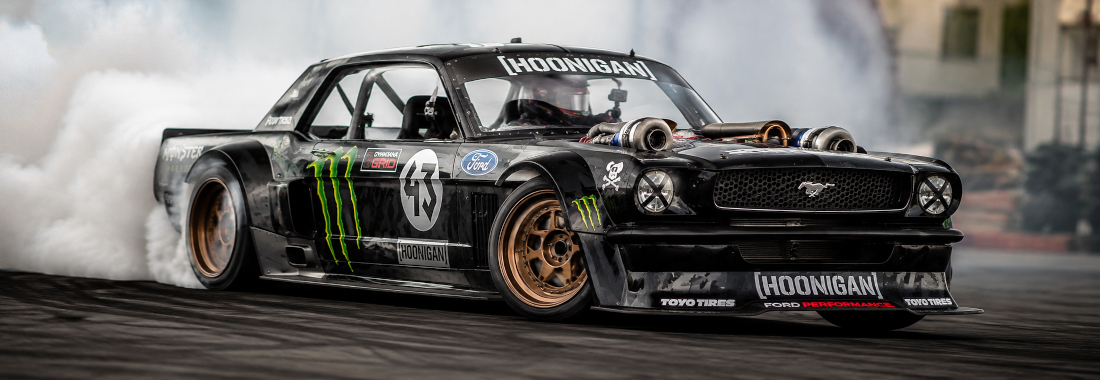
The first Hoonicorn, unveiled in 2014 during the SEMA Show and starring in Gymkhana 7, already impressed with its 845 horsepower generated by a monstrous naturally aspirated 6.7-liter V8 engine developed by Roush Yates. However, for Ken Block, that still was not enough. The ultimate evolution arrived in 2016 with the “Hoonicorn V2,” a version equipped with two massive Garrett GTX3584RS turbochargers and powered by methanol, increasing output to an absurd 1,400 horsepower.
The Hoonicorn’s twin-turbo V8 engine became a true legend among enthusiasts. Beyond the colossal power, the setup produced gigantic flames through the exhaust outlets positioned directly above the hood, creating a cinematic visual effect during filming. Methanol fuel was chosen not only for its ability to increase power, but also for its superior cooling capacity compared to conventional gasoline, eliminating the need for traditional intercoolers.
But power without control would not work for the Gymkhana videos. That is why one of the Hoonicorn’s greatest highlights was its AWD system — permanent all-wheel drive. Unlike most drift cars, which traditionally use rear-wheel drive, Ken Block’s Mustang featured a sophisticated Sadev AWD system capable of instantly distributing torque to all four wheels. This allowed violent acceleration, four-wheel drifts, and extremely aggressive direction changes, something that became one of the car’s visual trademarks.
The design also helped turn the Hoonicorn into an instant icon. Although it preserved the classic shape of the 1965 Mustang, virtually the entire body was replaced with ultra-light carbon fiber panels. The widened fenders made the car approximately nine inches wider, allowing it to accommodate massive Toyo tires capable of handling the brutal mechanical setup.
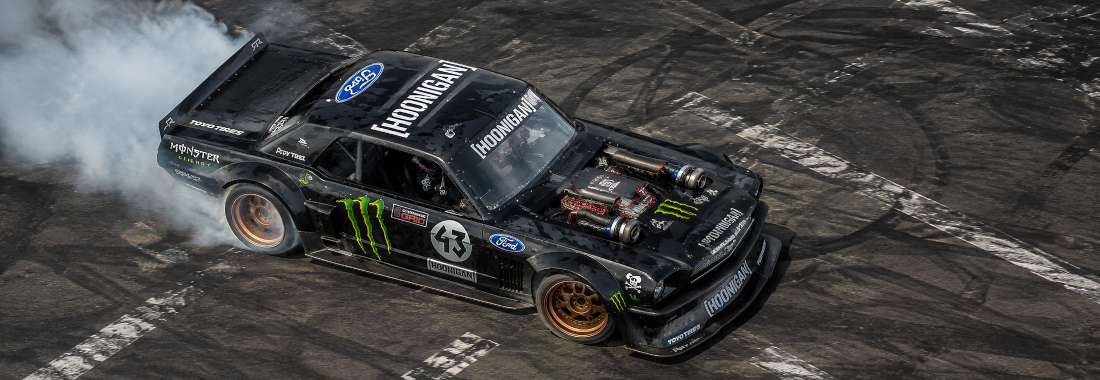
Visually, the Hoonicorn looked like a crossover between a classic muscle car, a Group B rally car, and a futuristic prototype. The massive hood scoop, aggressive air intakes, exposed turbochargers, and ultra-low stance created an intimidating presence. Even today, very few cars can project as much aggression while standing still as the Hoonicorn.
The interior followed the same extreme philosophy. Everything was designed for functionality and weight reduction: a carbon fiber dashboard, full roll cage, racing bucket seats, and a massive custom hydraulic handbrake built specifically for drift maneuvers. One interesting detail is that the handbrake system could partially disengage the center differential, helping Ken Block initiate insane slides even with all-wheel drive.
Another fascinating aspect of the Hoonicorn was its almost wild behavior. Ken Block himself described the car as “scary” to drive. According to the Hoonigan team, even at high speeds and with wide tires, the car would still lose traction during every gear shift due to the brutal torque delivered by the turbochargers.
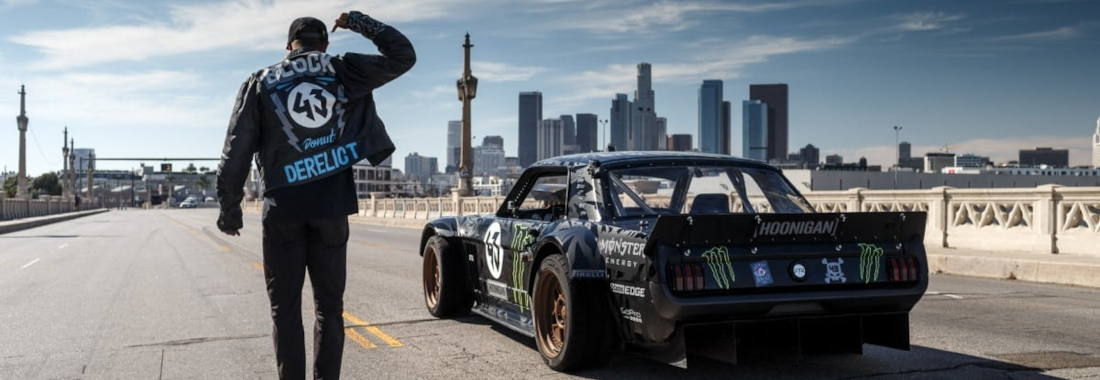
The Hoonicorn’s worldwide fame exploded thanks to the Gymkhana and Climbkhana videos. In Gymkhana 7, the car destroyed tires through the streets of Los Angeles in a sequence that quickly became viral. In Climbkhana, Ken Block took the Mustang to the dangerous curves of Pikes Peak, producing one of the most impressive audiovisual experiences ever created in digital motorsport.
Beyond filming, the Hoonicorn also starred in the “Hoonicorn Vs The World” series, competing against supercars and hypercars in drag races. In one of the most famous matchups, the 1,400-horsepower AWD Mustang defeated a McLaren Senna with incredible ease, thanks to its brutal combination of power, lightweight construction, and all-wheel drive traction.
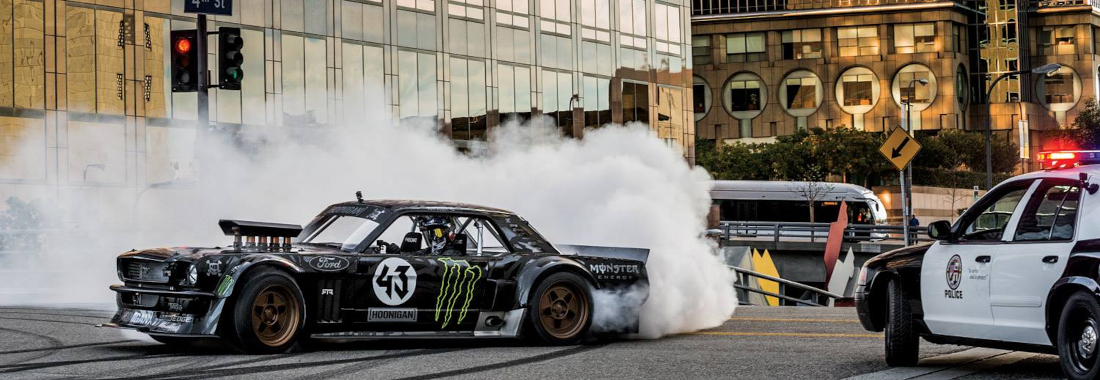
Interestingly, despite its global fame, the Hoonicorn was never built as a showroom car. The Hoonigan team treated the Mustang as a true competition machine, maintaining spare parts and accepting battle scars on the bodywork after extreme filming sessions. Some damage was even intentionally preserved, such as a small deformation near the rear caused during a climb at Pikes Peak.
The Hoonicorn’s legacy extended far beyond automotive videos. The car became a symbol of modern automotive culture, influencing builders, games, movies, events, and even the design of other radical projects. Many fans consider the Hoonicorn the most iconic Mustang of the contemporary era — not because of historical originality, but because of the absolute boldness of its concept.
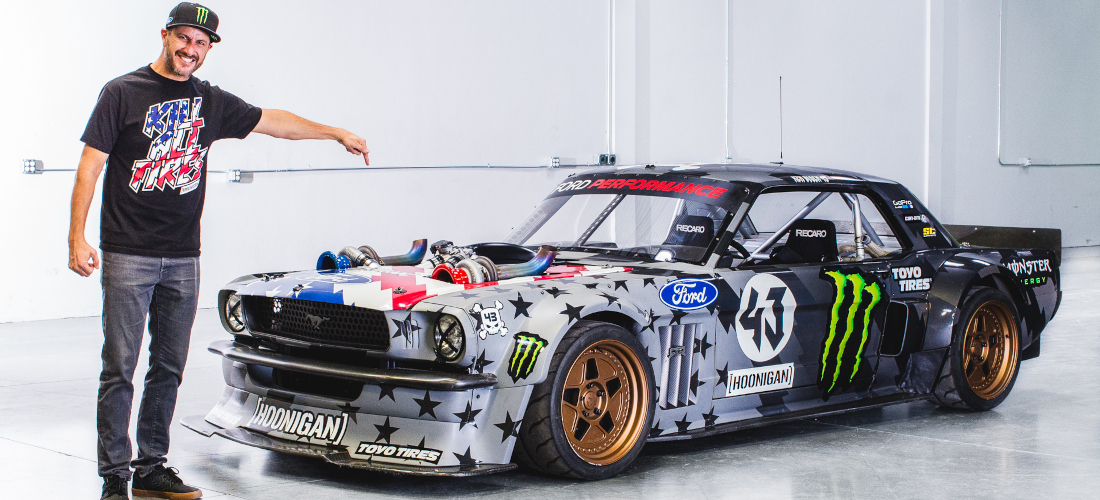
Even after Ken Block’s passing in 2023, the Hoonicorn remains one of the most recognizable machines on the planet. Its brutal engine sound, explosions of fire from the exhausts, and impossible drifts transformed the car into a true modern motorsport legend. More than just a Mustang, the Hoonicorn became a mechanical masterpiece created to push boundaries and immortalize Ken Block’s name in automotive history.